Pasquino
The DecameronPasquino is a young man of modest means whose work brings him into contact with Simona, a poor spinner in Florence. Their story begins in the ordinary exchange of wool and attention, then ends abruptly in a garden when he rubs a sage leaf against his teeth and dies. Because those present mistake the unexplained death for evidence of poisoning, Pasquino’s private romance becomes the cause of Simona’s arrest and a judge’s inquiry.
Identity and Circumstances
Pasquino is described as a young man no more highly placed than Simona. He works for a wool merchant, taking his master’s wool to women who spin it. Simona, who earns her bread by spinning, is among them. The arrangement makes their first connection both practical and unequal in its small details: Pasquino brings the work, while Simona performs it by hand to support herself.
His attention to her spinning exceeds what he gives the other workers. He watches her work with special diligence, as though the yarn she makes alone could supply all the cloth his master needs. The story presents this extra care as part of their courtship: work becomes a pretext for renewed attention, and attention becomes a way for each to show interest without immediately speaking openly.
Courtship and Secret Meeting
Simona has already welcomed love into her thoughts when Pasquino’s pleasing manner and words make his affection apparent. At first, she desires him but does not venture to act. Pasquino, for his part, is anxious that her spinning should be done well, and the two gradually move from guarded interest to a shared relationship. Their advances become mutual; neither waits consistently for the other to take the initiative. The account thus depicts their intimacy as reciprocated rather than as a pursuit undertaken by Pasquino alone.
As their affection grows, Pasquino proposes meeting in a garden where they can be together more comfortably and with less risk of suspicion. Simona agrees. On a Sunday after eating, she tells her father that she intends to go to San Gallo Gate for a religious pardon, then travels to the appointed garden with her friend Lagina. Pasquino arrives with his companion Puccino, commonly called Stramba. Stramba and Lagina form their own amorous pair, leaving Pasquino and Simona to withdraw to another part of the garden.
The lovers sit beside a large, handsome sage bush. Their meeting includes affection, conversation, and plans for a collation they intend to share there at their leisure. This ordinary prospect of eating together gives the scene its domestic ease: the garden is not merely a hiding place, but a setting in which the couple imagine continuing their pleasure in one another’s company.
The Sage and Pasquino’s Death
During the meeting, Pasquino plucks a leaf from the sage bush and rubs it against his teeth and gums. He says that sage cleans away anything left there after eating. The gesture is casual and practical, part of a conversation that turns back to their planned collation. Nothing in the account establishes that he expects danger from the plant or intends anything beyond cleaning his teeth.
Soon afterward his appearance changes. He loses his sight and speech and dies within a short time. Simona cries out and calls Stramba and Lagina; when they arrive, Pasquino’s body is swollen and marked with dark spots. The suddenness and visible condition of the corpse make the death alarming, but the story does not at this point provide a settled explanation for what caused it.
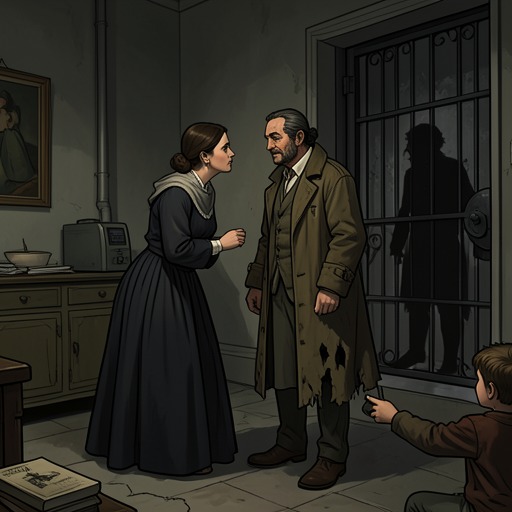
Stramba immediately accuses Simona of poisoning Pasquino. Neighbours hear the outcry and come to the garden, where they find the body and hear the accusation. Simona is overwhelmed by grief and cannot adequately defend herself. Those gathered accept Stramba’s account, and she is taken, still weeping, to the Provost’s palace. Pasquino’s death therefore changes the meaning of the lovers’ meeting in the eyes of the community: what had been a concealed rendezvous is treated as the scene of a crime.
Narrative Role and Consequences
The accusation against Simona is not supported by what the judge discovers in the initial examination. Unable to determine that she acted maliciously or was guilty, he goes to inspect the body and the place where Pasquino died. Simona recounts the sequence of events and demonstrates how Pasquino rubbed the sage leaf against his teeth. The judge’s inquiry returns attention to the physical action itself, distinguishing what happened from the confident interpretation imposed by Stramba and the other accusers.
Pasquino’s part in the story is brief, but the contrast between the lovers’ private understanding and the public reading of his death drives the episode. His care over Simona’s work, their reciprocal courtship, and their plans for a shared meal belong to a world of ordinary affection; his sudden death makes the same garden a place of suspicion and legal peril. The tale’s heading also records that Simona rubs a leaf from the same bush against her teeth while trying to show the judge what Pasquino did, and dies in like manner. The parallel makes the sage bush the episode’s central material mystery, while Pasquino’s death remains the event that first turns love into accusation.